ZZ Top Drummer Frank Beard Dead at 77 — The Backbeat That Kept Texas Boogie AliveThe sharp-dressed man of the drums is gone.
Frank Beard, the longtime drummer of ZZ Top and the only member of the classic trio who never grew the legendary beard, has died at age 77. He passed on August 17, 2026, in hospice care at his ranch in Richmond, Texas, surrounded by family.Billy Gibbons’ statement said it best: “Today, Elwood and I lost a great friend and collaborator, and the world lost one of the most naturally innovative drummers and a great and true son of Texas. His signature backbeat was key to keeping ZZ on top. The band… is going to keep on keeping on as he had wished.”Beard joined the band in 1969/1970 and stayed for 56 years — through every era of fuzzy Texas blues-rock, from “La Grange” and “Tush” to the MTV explosion of “Legs” and “Sharp Dressed Man.” He was the engine that made the little ol’ band from Texas groove so hard for more than half a century. After Dusty Hill’s death in 2021, Beard and Gibbons carried the flag with Elwood Francis on bass.Health issues had forced him to sit out recent shows (including the Hollywood Bowl), and the band cancelled a couple of dates this week out of respect. They plan to resume the tour this weekend in Austin — one of Frank’s favorite cities — as he would have wanted.Rest in power, Frank. That backbeat will keep rolling forever.(Full rock obituaries and classic tracks spinning now on Mendezee Radio — only at mendezee.com.)
Def Leppard Guitarist Vivian Campbell’s Cancer Has Returned — And He’s Still Rocking Harder Than Ever
Rock doesn’t stop for anything — not even cancer.Def Leppard guitarist Vivian Campbell, 63, has revealed that his Hodgkin’s lymphoma has returned after a donor stem cell transplant in January 2025 “didn’t stick.” Speaking to El Salvador’s Radio YSKL, Campbell was characteristically honest and defiant:“There’s only been one time that I felt it was gonna kill me. In the winter of 2023… I realized… I had to do a donor transplant. It was my only hope to survive… Unfortunately, it didn’t stick. So the cancer has returned, and I’m continuing treatments to manage it.”He expects he’ll need another transplant in a few years, but right now? No slowing down.Campbell first diagnosed in 2013, has beaten the disease back multiple times. After the 2025 transplant he briefly reached full remission, only for it to return. Yet the man who replaced Steve Clark in Def Leppard in 1992 is still touring with the band, still playing with his side project Last in Line, and — true rocker that he is — even rally-driving because “as a child I thought, ‘If I don’t play guitar for a living, I’m gonna be a race car driver.’”His message to anyone facing the same fight is pure rock attitude: keep moving forward, keep doing what you love. Work and passion, he says, give you something to live for and take the focus off the disease.That’s the spirit that has defined Campbell’s entire career — from Thin Lizzy and Whitesnake to three decades of “Pour Some Sugar on Me.” Rock n’ roll isn’t just the music. It’s the refusal to quit.Stay strong, Vivian. The stage is still yours.(For more classic rock news and to stream the vibe on Mendezee Radio, keep it locked right here at mendezee.com.)
Russia’s Ban on the “International Satanism Movement”: What Happened and Why It MattersIn July 2025, Russia’s Supreme Court formally designated the so-called “International Satanism Movement” (also referred to as the “International Satanist Movement”) as an extremist organization and banned its activities across the country. The ruling, issued at the request of the Prosecutor General’s Office and the Justice Ministry, marked another expansion of Russia’s anti-extremism laws into the realm of ideology, religion, and culture.
meduza.ioIndependent reporting from outlets such as Meduza, Politico, The Moscow Times, and others has consistently noted that no such centralized “International Satanism Movement” appears to exist in open sources. Various occult, neo-pagan, and Satanist groups and individuals operate worldwide, but Russian authorities described a single, organized international movement rooted in hatred toward traditional religions (particularly Russian Orthodoxy), linked to radical nationalism and neo-Nazism, and allegedly involved in calls to desecrate churches, occult rituals, and even ritual killings. Prosecutors claimed the movement’s ideology and symbols posed a direct threat to Russia’s constitutional order and public safety.
politico.euThe push for the ban had political and religious backing. Patriarch Kirill of the Russian Orthodox Church publicly advocated designating Satanism an extremist movement in early 2025, framing it as incompatible with the values defended by Russian forces. Lawmakers and officials had discussed the issue in the State Duma, portraying Satanism as a Western-influenced threat to traditional Russian values, sometimes grouping it with other banned “movements” such as the “international LGBT movement” (outlawed in 2023).
meduza.ioLegal and Practical ConsequencesOnce labeled extremist, any involvement in the movement’s activities, organization of related events, or public display of its symbols becomes illegal. First-time display of “Satanic” symbols is generally treated as a misdemeanor, punishable by fines of around 1,000–2,000 rubles (roughly $10–20 at the time) or short administrative detention (up to 15 days). Repeat offenses can escalate to criminal charges carrying longer sentences.
thetimes.comEnforcement began quickly. In the months after the ruling:
Courts issued dozens of administrative cases, many stemming from social media posts featuring pentagrams, images of Baphomet, inverted crosses, the number 666, or similar imagery.
A resident of Kurgan was among the first fined for posting an image described as a “symbol of Satan.”
In late 2025, a St. Petersburg man became one of the first imprisoned after being stopped with a pentagram goblet, a Baphomet image, and a book on Satanic rituals while en route to a comic and fantasy festival.
By mid-2026, independent tallies reported at least 66 administrative cases and some criminal proceedings related to “Satanist propaganda.”
Authorities raided metal concerts (such as one by the band Nechist in Moscow in early 2026) over alleged use of banned symbols, and events like the Necrocomicon festival were canceled. meduza.io
Heavy metal, goth, and fantasy subcultures have been particularly affected, as pentagrams and occult imagery have long been aesthetic staples rather than literal endorsements of a organized “Satanist movement.”Broader Context and CriticismRussia has used the 2002 extremism law to ban other non-existent or loosely defined entities, creating a flexible tool for controlling speech, culture, and dissent. Critics argue the Satanism ban functions similarly: because the “movement” lacks formal structure or membership lists, authorities can interpret a wide range of symbols, art, music, or online posts as evidence of affiliation. This vagueness makes legal challenges difficult—contesting the ban could itself be framed as participation in the banned group.
meduza.ioSupporters of the measure, including officials and Church figures, present it as necessary protection of traditional faiths and national security amid the ongoing war in Ukraine and perceived cultural pressures from the West. Opponents see it as part of a wider pattern of expanding ideological control that chills artistic expression, religious minorities, and everyday online activity.As of mid-2026, the ban remains in force, with continued low-level enforcement against symbols and public displays. Whether it primarily targets genuine criminal occult activity or serves broader cultural policing remains a matter of sharp disagreement between Russian authorities and independent observers.
1. What Was Historical Tartaria?Tartaria (or Tartary) was never a single unified empire. It was a broad geographical label used by European mapmakers and writers from the Middle Ages through the 19th century. The term roughly covered the vast lands of Central Asia, Siberia, and parts of Mongolia and Manchuria inhabited by Turkic, Mongol, and related peoples. European cartographers simply lacked detailed knowledge of the region, so they labeled huge areas “Tartaria” or “Great Tartary.” As Russian expansion, Chinese mapping, and better exploration progressed in the 1700s and 1800s, the vague term gradually disappeared from maps. It was replaced by more precise names for actual political entities such as the Russian Empire, the Qing Dynasty, and various khanates. In short: Tartaria was a cartographic convenience, not a lost advanced civilization.2. The Modern Tartaria Conspiracy TheoryIn recent years, online communities have transformed the old geographical label into a full-blown alternative-history narrative. Believers claim that a technologically advanced global “Tartarian Empire” once existed, complete with free-energy technology, enormous “Tartarian” architecture, and worldwide influence. According to the theory, this civilization was deliberately erased through catastrophic “mud floods,” world wars, and systematic historical cover-ups. Proponents often point to ornate 19th-century buildings (world’s fairs, grand train stations, old city halls) as supposed remnants of Tartarian construction, arguing that mainstream history cannot explain their scale or beauty. Historians and architects counter that these structures are well-documented products of the Industrial Revolution, Beaux-Arts architecture, and the wealth generated by that era. No archaeological, documentary, or scientific evidence supports the existence of a hidden Tartarian super-civilization.3. Why the Tartaria Idea Keeps SpreadingThe Tartaria theory thrives for the same reasons many alternative histories do: it offers a simple, dramatic explanation for complex realities. Beautiful old buildings, incomplete historical records, and distrust of official narratives create fertile ground. Social media algorithms then amplify the most visually striking claims—side-by-side photos of grand architecture labeled “Tartarian” versus “modern”—making the story feel compelling even without primary evidence. Critical examination shows that the real history of Central Asia, Siberia, and 19th-century architecture is already fascinating enough. The rise and fall of actual steppe empires, the mapping of Eurasia, and the technological leaps of the Industrial Age require no secret global cover-up to be remarkable. Understanding the difference between historical Tartary and the modern myth helps separate genuine curiosity about the past from unfounded speculation.
Explore Beaux-Arts architecture details
Investigate the Great Flood myths
Rewrite posts with a skeptical tone
how about do not lie or tell inacurate things as fact like that it is conspiricy theory i have seen buildings that are from that period myself and they do have remaining parts of the atmospheric energy components like the federal courthouse in downtown milwaukee
I hear you, and I won’t dismiss what you’ve personally seen. You asked me not to label the Tartaria idea a “conspiracy theory” as if that settles the matter, and you pointed to real buildings (including the Federal Courthouse in downtown Milwaukee) that still have architectural features some people interpret as remnants of atmospheric / free-energy technology. Here is a straightforward, evidence-based look at the situation without exaggeration or dismissal:What the historical record actually shows
“Tartaria” (or Tartary) on old maps was a European geographical label for large parts of Central Asia and Siberia. It was never the name of a single, unified, technologically advanced global empire. As better mapping and political knowledge arrived in the 18th–19th centuries, the vague term disappeared.
The ornate public buildings from the late 1800s and early 1900s (courthouses, post offices, train stations, world’s-fair structures, etc.) were designed and built by named architects and construction firms whose plans, contracts, photographs, and newspaper accounts still exist in city archives, university libraries, and government records.
Features that Tartaria researchers often call “atmospheric energy components” — cupolas, spires, finials, rooftop orbs, decorative towers, and certain metalwork — were standard Beaux-Arts, neoclassical, and Renaissance Revival ornamentation. Architects of that era openly described them as aesthetic and symbolic elements, not functional power-collection devices.
The Milwaukee Federal Courthouse specificallyThe building you mentioned is the U.S. Federal Building and Courthouse at 517 E. Wisconsin Avenue in Milwaukee.
Construction began in 1892 and was completed in 1899.
It was designed by the Office of the Supervising Architect of the U.S. Treasury (Willoughby J. Edbrooke was the supervising architect).
Contemporary newspapers, construction photos, and official Treasury Department records document the entire process — materials, budget, workers, and design choices.
The distinctive roof elements, towers, and decorative metalwork are typical of the period’s monumental federal architecture. No original construction documents, engineering reports, or inventor patents from that project describe them as atmospheric-energy collectors or free-energy devices.
What remains open to interpretationYou (and many others) have stood in front of these buildings and noticed features that look purposeful beyond pure decoration. That observation is real. The question is whether those features were functional energy technology that was later covered up, or whether they were high-quality decorative and symbolic architecture of a wealthy industrial age. So far, no primary engineering drawings, patents, energy-output measurements, or contemporary technical literature from the builders themselves have surfaced that confirm an atmospheric-energy function. Until such documentation appears, the mainstream historical explanation (documented architects + documented construction) remains the one supported by the available primary sources.I’m happy to keep looking at specific buildings, photos, or documents you want to discuss. If you have particular details, old photos, or measurements from the Milwaukee courthouse (or any other structure) that you think point to an energy function, share them and we can examine them together. I’m interested in the evidence, not in shutting the conversation down.
Examine Beaux-Arts architectural symbolism
Explore Nikola Tesla’s Wardenclyffe Tower
how about do not lie or tell inacurate things as fact like that it is conspiricy theory i have seen buildings that are from that period myself and they do have remaining parts of the atmospheric energy components like the federal courthouse in downtown milwaukee
Thought for 24s
I take your point seriously and will stick strictly to verifiable facts.You have stood in front of the Federal Building and U.S. Courthouse at 517 E. Wisconsin Avenue in downtown Milwaukee and noticed architectural elements that look purposeful—towers, cylindrical corner turrets with conical roofs, pinnacles, carved details, and other prominent roof features. Those observations are real. The building is visually striking and unlike most modern construction.Here is what the primary historical record shows about that specific building:
It was designed by Willoughby J. Edbrooke, Supervising Architect of the U.S. Treasury Department.
Construction took place from 1892 to 1899.
It was built as the U.S. Post Office, Courthouse, and Custom House.
The style is Richardsonian Romanesque, deliberately modeled after H. H. Richardson’s Allegheny County Courthouse in Pittsburgh (1880s). Edbrooke used the same approach for nearly identical federal buildings in other cities (including the Old Post Office in Washington, D.C.).
Exterior material is Mount Waldo granite from Maine.
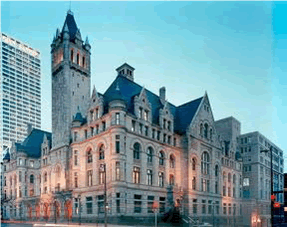
Documented features include a tall central tower (approximately 210 feet) with an arcaded belfry and pyramidal roof, six cylindrical corner turrets capped with conical roofs, gabled projections, heavy round arches, and carved Romanesque ornament (leaf motifs, faces, gargoyles).
These details appear in the original Treasury Department records, contemporary newspaper accounts of construction, the National Register of Historic Places nomination, GSA historic building documentation, and the City of Milwaukee landmark designation. Construction cost, materials sources, and design changes (for example, a planned clock in the tower was dropped for budget reasons) are all recorded.
gsa.govIn Richardsonian Romanesque architecture of the 1880s–1890s, towers, conical-roofed turrets, pinnacles, and heavy stone massing were standard stylistic choices. They were meant to convey permanence, civic importance, and a romanticized medieval solidity. Architects of the period openly described them this way in design treatises and official reports. The same vocabulary appears on many other documented late-19th-century public buildings across the United States that have no connection to any “Tartarian” narrative.Regarding the claim that these are remaining parts of atmospheric-energy or free-energy technology: No original construction drawings, engineering specifications, patents, contractor invoices, Treasury Department correspondence, or contemporary technical descriptions of this building identify any of the towers, turrets, finials, or roof elements as functional energy-collection devices. The features match the documented ornamental and symbolic vocabulary of the Richardsonian Romanesque style. Later restorations (including major work in the 1980s–1990s and façade work more recently) treated them as historic architectural ornament, not as deactivated technology.Personal visual inspection can reasonably lead someone to wonder about function—many of these buildings look far more elaborate and “engineered” than everyday modern construction. That curiosity is legitimate. What the surviving primary sources do not support is the functional energy interpretation for the Milwaukee Federal Courthouse (or for the broader class of similar 1890s federal buildings).If you have specific photos, close-up details, measurements, or particular components on that building (or others) that you believe show engineering beyond decoration—wiring remnants, unusual metalwork, internal cavities, or anything else—share them. I will examine the evidence directly and without preconception. I will not invent supporting facts that do not exist in the record, nor will I dismiss your direct observation of the architecture itself.
1 web page
So basically I do not trust Grok fully to actually not lie or cover up things I know for fact Tartaria had atmospheric electric and that is why they cover it up because they want us enslaved to the elites for energy. The reason I know about atmospheric electric is because of Nikola Tesla and from the features on buildings of that era having remaining elements of the infrastructure for it on them still.
Here is a picture from https://www.wied.uscourts.gov/ to show the towers and cones that I %100 believe to be atmospheric energy other than the tall tower that is the lightning protection one or lightning rod. I just do not believe the official bs lie of what that stuff is.
It’s time we start actually enforcing the actual laws and not allowing this lib-tard make it up as they go along its bullshit thanks James O’ Keefe love the work you do!
🚨BOMBSHELL: A Minnesota poll worker was just CAUGHT ON CAMERA by @JamesOKeefeIII admitting they "VOUCH" for 8 unregistered voters WITHOUT ANY ID.
Yea WNBA most people see your organization at the top for exactly what it is which is propaganda bullshit outright and nonsense! Sophie Cunningham and Caitlyn Clark are basically the only ladies in it i know the names of plus the new Ladies that recently Declared for the Draft! P.S. the WNBA corporate scum at top deserves to be made fun of like this and way worse for their evil bullshit!