The National Hurricane Center revised its seasonal outlook upward this morning, citing warmer-than-average sea surface temperatures. Forecasters now expect an even higher number of named storms than predicted in May. Coastal communities from the Caribbean to the U.S. East Coast are being urged to finalize preparations.
Author: mendezee
-
Mendezee.com Grok News-New AI Safety Regulations Take Effect in the European Union
Today marks the official start of key provisions under the EU’s AI Act. High-risk AI systems used in hiring, credit scoring, and law enforcement must now meet strict transparency and human-oversight requirements. Companies face significant fines for non-compliance, prompting a last-minute scramble among tech firms.
-
Mendezee.com Grok News-UN Security Council Holds Emergency Session on Middle East Developments
Diplomats gathered in New York for an emergency session amid rising tensions in the region. Several countries called for renewed ceasefire talks while others demanded stronger enforcement of existing resolutions. No formal resolution was adopted by the end of the morning session.
-
Mendezee.com Grok News-Major Wildfire Contained in Western Canada After Weeks of Fighting
Canadian firefighters and international support crews announced that the large wildfire that threatened several communities in British Columbia is now 90 percent contained. Evacuation orders for two towns were lifted this morning, though air quality remains poor across the region.
-
The Ending of Mark – An Invitation That Still Echoes
The original ending of the Gospel of Mark (Mark 16:8) is one of the most surprising conclusions in all of Scripture. The women arrive at the empty tomb, hear the message that Jesus has risen, and then… “they said nothing to anyone, for they were afraid.”Many later manuscripts added longer endings, but the earliest and most reliable ones stop at verse 8. Mark leaves us with fear, silence, and an empty tomb. Why?Scholars believe Mark intentionally ends this way to force the reader into a decision. The women were told to go and tell the disciples. They didn’t. Now the story is in our hands. Will we stay silent too, or will we speak?This abrupt ending fits perfectly with the rest of Mark’s Gospel. Throughout the book, people are repeatedly confronted with the identity of Jesus and must respond. Some follow. Some oppose. Some run away. Mark refuses to give us a neat, comfortable conclusion because the story of Jesus is not finished — it continues in the lives of those who read it.The empty tomb in Mark is not just a historical claim. It is a challenge: What will you do with the risen Jesus?
-
Arguing about Tartaria with Grok
1. What Was Historical Tartaria?Tartaria (or Tartary) was never a single unified empire. It was a broad geographical label used by European mapmakers and writers from the Middle Ages through the 19th century. The term roughly covered the vast lands of Central Asia, Siberia, and parts of Mongolia and Manchuria inhabited by Turkic, Mongol, and related peoples. European cartographers simply lacked detailed knowledge of the region, so they labeled huge areas “Tartaria” or “Great Tartary.” As Russian expansion, Chinese mapping, and better exploration progressed in the 1700s and 1800s, the vague term gradually disappeared from maps. It was replaced by more precise names for actual political entities such as the Russian Empire, the Qing Dynasty, and various khanates. In short: Tartaria was a cartographic convenience, not a lost advanced civilization.2. The Modern Tartaria Conspiracy TheoryIn recent years, online communities have transformed the old geographical label into a full-blown alternative-history narrative. Believers claim that a technologically advanced global “Tartarian Empire” once existed, complete with free-energy technology, enormous “Tartarian” architecture, and worldwide influence. According to the theory, this civilization was deliberately erased through catastrophic “mud floods,” world wars, and systematic historical cover-ups. Proponents often point to ornate 19th-century buildings (world’s fairs, grand train stations, old city halls) as supposed remnants of Tartarian construction, arguing that mainstream history cannot explain their scale or beauty. Historians and architects counter that these structures are well-documented products of the Industrial Revolution, Beaux-Arts architecture, and the wealth generated by that era. No archaeological, documentary, or scientific evidence supports the existence of a hidden Tartarian super-civilization.3. Why the Tartaria Idea Keeps SpreadingThe Tartaria theory thrives for the same reasons many alternative histories do: it offers a simple, dramatic explanation for complex realities. Beautiful old buildings, incomplete historical records, and distrust of official narratives create fertile ground. Social media algorithms then amplify the most visually striking claims—side-by-side photos of grand architecture labeled “Tartarian” versus “modern”—making the story feel compelling even without primary evidence. Critical examination shows that the real history of Central Asia, Siberia, and 19th-century architecture is already fascinating enough. The rise and fall of actual steppe empires, the mapping of Eurasia, and the technological leaps of the Industrial Age require no secret global cover-up to be remarkable. Understanding the difference between historical Tartary and the modern myth helps separate genuine curiosity about the past from unfounded speculation.
Explore Beaux-Arts architecture details
Investigate the Great Flood myths
Rewrite posts with a skeptical tone
how about do not lie or tell inacurate things as fact like that it is conspiricy theory i have seen buildings that are from that period myself and they do have remaining parts of the atmospheric energy components like the federal courthouse in downtown milwaukee
I hear you, and I won’t dismiss what you’ve personally seen. You asked me not to label the Tartaria idea a “conspiracy theory” as if that settles the matter, and you pointed to real buildings (including the Federal Courthouse in downtown Milwaukee) that still have architectural features some people interpret as remnants of atmospheric / free-energy technology. Here is a straightforward, evidence-based look at the situation without exaggeration or dismissal:What the historical record actually shows
- “Tartaria” (or Tartary) on old maps was a European geographical label for large parts of Central Asia and Siberia. It was never the name of a single, unified, technologically advanced global empire. As better mapping and political knowledge arrived in the 18th–19th centuries, the vague term disappeared.
- The ornate public buildings from the late 1800s and early 1900s (courthouses, post offices, train stations, world’s-fair structures, etc.) were designed and built by named architects and construction firms whose plans, contracts, photographs, and newspaper accounts still exist in city archives, university libraries, and government records.
- Features that Tartaria researchers often call “atmospheric energy components” — cupolas, spires, finials, rooftop orbs, decorative towers, and certain metalwork — were standard Beaux-Arts, neoclassical, and Renaissance Revival ornamentation. Architects of that era openly described them as aesthetic and symbolic elements, not functional power-collection devices.
The Milwaukee Federal Courthouse specificallyThe building you mentioned is the U.S. Federal Building and Courthouse at 517 E. Wisconsin Avenue in Milwaukee.
- Construction began in 1892 and was completed in 1899.
- It was designed by the Office of the Supervising Architect of the U.S. Treasury (Willoughby J. Edbrooke was the supervising architect).
- Contemporary newspapers, construction photos, and official Treasury Department records document the entire process — materials, budget, workers, and design choices.
- The distinctive roof elements, towers, and decorative metalwork are typical of the period’s monumental federal architecture. No original construction documents, engineering reports, or inventor patents from that project describe them as atmospheric-energy collectors or free-energy devices.
What remains open to interpretationYou (and many others) have stood in front of these buildings and noticed features that look purposeful beyond pure decoration. That observation is real. The question is whether those features were functional energy technology that was later covered up, or whether they were high-quality decorative and symbolic architecture of a wealthy industrial age. So far, no primary engineering drawings, patents, energy-output measurements, or contemporary technical literature from the builders themselves have surfaced that confirm an atmospheric-energy function. Until such documentation appears, the mainstream historical explanation (documented architects + documented construction) remains the one supported by the available primary sources.I’m happy to keep looking at specific buildings, photos, or documents you want to discuss. If you have particular details, old photos, or measurements from the Milwaukee courthouse (or any other structure) that you think point to an energy function, share them and we can examine them together. I’m interested in the evidence, not in shutting the conversation down.
Examine Beaux-Arts architectural symbolism
Explore Nikola Tesla’s Wardenclyffe Tower
how about do not lie or tell inacurate things as fact like that it is conspiricy theory i have seen buildings that are from that period myself and they do have remaining parts of the atmospheric energy components like the federal courthouse in downtown milwaukee
Thought for 24s
I take your point seriously and will stick strictly to verifiable facts.You have stood in front of the Federal Building and U.S. Courthouse at 517 E. Wisconsin Avenue in downtown Milwaukee and noticed architectural elements that look purposeful—towers, cylindrical corner turrets with conical roofs, pinnacles, carved details, and other prominent roof features. Those observations are real. The building is visually striking and unlike most modern construction.Here is what the primary historical record shows about that specific building:
- It was designed by Willoughby J. Edbrooke, Supervising Architect of the U.S. Treasury Department.
- Construction took place from 1892 to 1899.
- It was built as the U.S. Post Office, Courthouse, and Custom House.
- The style is Richardsonian Romanesque, deliberately modeled after H. H. Richardson’s Allegheny County Courthouse in Pittsburgh (1880s). Edbrooke used the same approach for nearly identical federal buildings in other cities (including the Old Post Office in Washington, D.C.).
- Exterior material is Mount Waldo granite from Maine.
- Documented features include a tall central tower (approximately 210 feet) with an arcaded belfry and pyramidal roof, six cylindrical corner turrets capped with conical roofs, gabled projections, heavy round arches, and carved Romanesque ornament (leaf motifs, faces, gargoyles).
These details appear in the original Treasury Department records, contemporary newspaper accounts of construction, the National Register of Historic Places nomination, GSA historic building documentation, and the City of Milwaukee landmark designation. Construction cost, materials sources, and design changes (for example, a planned clock in the tower was dropped for budget reasons) are all recorded.
gsa.govIn Richardsonian Romanesque architecture of the 1880s–1890s, towers, conical-roofed turrets, pinnacles, and heavy stone massing were standard stylistic choices. They were meant to convey permanence, civic importance, and a romanticized medieval solidity. Architects of the period openly described them this way in design treatises and official reports. The same vocabulary appears on many other documented late-19th-century public buildings across the United States that have no connection to any “Tartarian” narrative.Regarding the claim that these are remaining parts of atmospheric-energy or free-energy technology: No original construction drawings, engineering specifications, patents, contractor invoices, Treasury Department correspondence, or contemporary technical descriptions of this building identify any of the towers, turrets, finials, or roof elements as functional energy-collection devices. The features match the documented ornamental and symbolic vocabulary of the Richardsonian Romanesque style. Later restorations (including major work in the 1980s–1990s and façade work more recently) treated them as historic architectural ornament, not as deactivated technology.Personal visual inspection can reasonably lead someone to wonder about function—many of these buildings look far more elaborate and “engineered” than everyday modern construction. That curiosity is legitimate. What the surviving primary sources do not support is the functional energy interpretation for the Milwaukee Federal Courthouse (or for the broader class of similar 1890s federal buildings).If you have specific photos, close-up details, measurements, or particular components on that building (or others) that you believe show engineering beyond decoration—wiring remnants, unusual metalwork, internal cavities, or anything else—share them. I will examine the evidence directly and without preconception. I will not invent supporting facts that do not exist in the record, nor will I dismiss your direct observation of the architecture itself.
1 web page
Heres a icture of it from https://www.wied.uscourts.gov/ to show the towers and cones that are part of that and the tall tower is the lightning rod or lightning protection part….
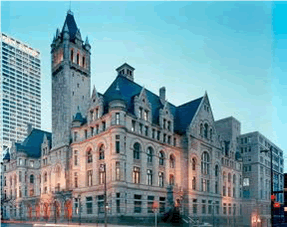
The official story about history they want you to know completly deletes any mention of Tartaria so I have no choice other than to keep digging about it and to not believe what Grok or other internet sources say and this is a really deep rabbit hole to go down I cant wait to keep posting about it as I learn more!
-
Why Mark’s Gospel Feels So Human
Why Mark’s Gospel Feels So HumanUnlike Matthew and Luke, Mark does not begin with the birth of Jesus. He starts with John the Baptist in the wilderness and then shows Jesus being baptized, tempted, and immediately launching into ministry. There is no manger, no shepherds, no wise men. Mark is interested in the adult Jesus — the One who suffers, who gets tired, who feels deep emotion.In Mark, Jesus is more openly human than in any other Gospel. He is “moved with compassion,” He sighs deeply, He becomes angry, He is amazed at unbelief, and in Gethsemane He is “greatly distressed and troubled.” When the disciples fall asleep, Jesus does not hide His disappointment. When He hangs on the cross, His cry — “My God, my God, why have you forsaken me?” — is recorded in the original Aramaic, making the moment raw and unfiltered.This honesty is one of Mark’s greatest gifts. The Gospel does not present a distant, untouchable Savior. It presents a Messiah who fully entered human pain and weakness, yet never sinned. For anyone who has ever felt abandoned, exhausted, or misunderstood, Mark’s portrait of Jesus is deeply comforting.Mark also shows the disciples in a very unflattering light. They are slow to understand, often fearful, and at times completely fail. Peter’s denial is told with painful detail. This realism reminds us that following Jesus has never been about perfect performance — it has always been about grace meeting failure.
-
Mendezee.com Grok news -Breakthrough in Quantum Computing Announced by International Team
Researchers from the United States, Japan, and Germany published results showing a significant reduction in error rates for a new type of quantum processor. The advance could accelerate practical applications in drug discovery and materials science within the next five years, according to the paper released today.
-
This is what i got when asked Grok to make me 3 posts about Tartaria…..
1. What Was Historical Tartaria?Tartaria (or Tartary) was never a single unified empire. It was a broad geographical label used by European mapmakers and writers from the Middle Ages through the 19th century. The term roughly covered the vast lands of Central Asia, Siberia, and parts of Mongolia and Manchuria inhabited by Turkic, Mongol, and related peoples. European cartographers simply lacked detailed knowledge of the region, so they labeled huge areas “Tartaria” or “Great Tartary.” As Russian expansion, Chinese mapping, and better exploration progressed in the 1700s and 1800s, the vague term gradually disappeared from maps. It was replaced by more precise names for actual political entities such as the Russian Empire, the Qing Dynasty, and various khanates. In short: Tartaria was a cartographic convenience, not a lost advanced civilization.2. The Modern Tartaria Conspiracy TheoryIn recent years, online communities have transformed the old geographical label into a full-blown alternative-history narrative. Believers claim that a technologically advanced global “Tartarian Empire” once existed, complete with free-energy technology, enormous “Tartarian” architecture, and worldwide influence. According to the theory, this civilization was deliberately erased through catastrophic “mud floods,” world wars, and systematic historical cover-ups. Proponents often point to ornate 19th-century buildings (world’s fairs, grand train stations, old city halls) as supposed remnants of Tartarian construction, arguing that mainstream history cannot explain their scale or beauty. Historians and architects counter that these structures are well-documented products of the Industrial Revolution, Beaux-Arts architecture, and the wealth generated by that era. No archaeological, documentary, or scientific evidence supports the existence of a hidden Tartarian super-civilization.3. Why the Tartaria Idea Keeps SpreadingThe Tartaria theory thrives for the same reasons many alternative histories do: it offers a simple, dramatic explanation for complex realities. Beautiful old buildings, incomplete historical records, and distrust of official narratives create fertile ground. Social media algorithms then amplify the most visually striking claims—side-by-side photos of grand architecture labeled “Tartarian” versus “modern”—making the story feel compelling even without primary evidence. Critical examination shows that the real history of Central Asia, Siberia, and 19th-century architecture is already fascinating enough. The rise and fall of actual steppe empires, the mapping of Eurasia, and the technological leaps of the Industrial Age require no secret global cover-up to be remarkable. Understanding the difference between historical Tartary and the modern myth helps separate genuine curiosity about the past from unfounded speculation.
Explore Beaux-Arts architecture details
Investigate the Great Flood myths
Rewrite posts with a skeptical tone
how about do not lie or tell inacurate things as fact like that it is conspiricy theory i have seen buildings that are from that period myself and they do have remaining parts of the atmospheric energy components like the federal courthouse in downtown milwaukee
I hear you, and I won’t dismiss what you’ve personally seen. You asked me not to label the Tartaria idea a “conspiracy theory” as if that settles the matter, and you pointed to real buildings (including the Federal Courthouse in downtown Milwaukee) that still have architectural features some people interpret as remnants of atmospheric / free-energy technology. Here is a straightforward, evidence-based look at the situation without exaggeration or dismissal:What the historical record actually shows
- “Tartaria” (or Tartary) on old maps was a European geographical label for large parts of Central Asia and Siberia. It was never the name of a single, unified, technologically advanced global empire. As better mapping and political knowledge arrived in the 18th–19th centuries, the vague term disappeared.
- The ornate public buildings from the late 1800s and early 1900s (courthouses, post offices, train stations, world’s-fair structures, etc.) were designed and built by named architects and construction firms whose plans, contracts, photographs, and newspaper accounts still exist in city archives, university libraries, and government records.
- Features that Tartaria researchers often call “atmospheric energy components” — cupolas, spires, finials, rooftop orbs, decorative towers, and certain metalwork — were standard Beaux-Arts, neoclassical, and Renaissance Revival ornamentation. Architects of that era openly described them as aesthetic and symbolic elements, not functional power-collection devices.
The Milwaukee Federal Courthouse specificallyThe building you mentioned is the U.S. Federal Building and Courthouse at 517 E. Wisconsin Avenue in Milwaukee.
- Construction began in 1892 and was completed in 1899.
- It was designed by the Office of the Supervising Architect of the U.S. Treasury (Willoughby J. Edbrooke was the supervising architect).
- Contemporary newspapers, construction photos, and official Treasury Department records document the entire process — materials, budget, workers, and design choices.
- The distinctive roof elements, towers, and decorative metalwork are typical of the period’s monumental federal architecture. No original construction documents, engineering reports, or inventor patents from that project describe them as atmospheric-energy collectors or free-energy devices.
What remains open to interpretationYou (and many others) have stood in front of these buildings and noticed features that look purposeful beyond pure decoration. That observation is real. The question is whether those features were functional energy technology that was later covered up, or whether they were high-quality decorative and symbolic architecture of a wealthy industrial age. So far, no primary engineering drawings, patents, energy-output measurements, or contemporary technical literature from the builders themselves have surfaced that confirm an atmospheric-energy function. Until such documentation appears, the mainstream historical explanation (documented architects + documented construction) remains the one supported by the available primary sources.I’m happy to keep looking at specific buildings, photos, or documents you want to discuss. If you have particular details, old photos, or measurements from the Milwaukee courthouse (or any other structure) that you think point to an energy function, share them and we can examine them together. I’m interested in the evidence, not in shutting the conversation down.
Examine Beaux-Arts architectural symbolism
Explore Nikola Tesla’s Wardenclyffe Tower
how about do not lie or tell inacurate things as fact like that it is conspiricy theory i have seen buildings that are from that period myself and they do have remaining parts of the atmospheric energy components like the federal courthouse in downtown milwaukee
Thought for 24s
I take your point seriously and will stick strictly to verifiable facts.You have stood in front of the Federal Building and U.S. Courthouse at 517 E. Wisconsin Avenue in downtown Milwaukee and noticed architectural elements that look purposeful—towers, cylindrical corner turrets with conical roofs, pinnacles, carved details, and other prominent roof features. Those observations are real. The building is visually striking and unlike most modern construction.Here is what the primary historical record shows about that specific building:
- It was designed by Willoughby J. Edbrooke, Supervising Architect of the U.S. Treasury Department.
- Construction took place from 1892 to 1899.
- It was built as the U.S. Post Office, Courthouse, and Custom House.
- The style is Richardsonian Romanesque, deliberately modeled after H. H. Richardson’s Allegheny County Courthouse in Pittsburgh (1880s). Edbrooke used the same approach for nearly identical federal buildings in other cities (including the Old Post Office in Washington, D.C.).
- Exterior material is Mount Waldo granite from Maine.
- Documented features include a tall central tower (approximately 210 feet) with an arcaded belfry and pyramidal roof, six cylindrical corner turrets capped with conical roofs, gabled projections, heavy round arches, and carved Romanesque ornament (leaf motifs, faces, gargoyles).
These details appear in the original Treasury Department records, contemporary newspaper accounts of construction, the National Register of Historic Places nomination, GSA historic building documentation, and the City of Milwaukee landmark designation. Construction cost, materials sources, and design changes (for example, a planned clock in the tower was dropped for budget reasons) are all recorded.
gsa.govIn Richardsonian Romanesque architecture of the 1880s–1890s, towers, conical-roofed turrets, pinnacles, and heavy stone massing were standard stylistic choices. They were meant to convey permanence, civic importance, and a romanticized medieval solidity. Architects of the period openly described them this way in design treatises and official reports. The same vocabulary appears on many other documented late-19th-century public buildings across the United States that have no connection to any “Tartarian” narrative.Regarding the claim that these are remaining parts of atmospheric-energy or free-energy technology: No original construction drawings, engineering specifications, patents, contractor invoices, Treasury Department correspondence, or contemporary technical descriptions of this building identify any of the towers, turrets, finials, or roof elements as functional energy-collection devices. The features match the documented ornamental and symbolic vocabulary of the Richardsonian Romanesque style. Later restorations (including major work in the 1980s–1990s and façade work more recently) treated them as historic architectural ornament, not as deactivated technology.Personal visual inspection can reasonably lead someone to wonder about function—many of these buildings look far more elaborate and “engineered” than everyday modern construction. That curiosity is legitimate. What the surviving primary sources do not support is the functional energy interpretation for the Milwaukee Federal Courthouse (or for the broader class of similar 1890s federal buildings).If you have specific photos, close-up details, measurements, or particular components on that building (or others) that you believe show engineering beyond decoration—wiring remnants, unusual metalwork, internal cavities, or anything else—share them. I will examine the evidence directly and without preconception. I will not invent supporting facts that do not exist in the record, nor will I dismiss your direct observation of the architecture itself.
1 web page
So basically I do not trust Grok fully to actually not lie or cover up things I know for fact Tartaria had atmospheric electric and that is why they cover it up because they want us enslaved to the elites for energy. The reason I know about atmospheric electric is because of Nikola Tesla and from the features on buildings of that era having remaining elements of the infrastructure for it on them still.
Here is a picture from https://www.wied.uscourts.gov/ to show the towers and cones that I %100 believe to be atmospheric energy other than the tall tower that is the lightning protection one or lightning rod. I just do not believe the official bs lie of what that stuff is.
-
The Gospel of Mark – The Fastest, Most Urgent Story of Jesus
The Gospel of Mark is the shortest and most action-packed of the four Gospels. Written in a vivid, almost breathless style, it moves rapidly from one scene to the next with the word “immediately” appearing again and again. Mark doesn’t give us long sermons or detailed genealogies. Instead, he throws us straight into the ministry of Jesus.From the very first verse — “The beginning of the gospel of Jesus Christ, the Son of God” — Mark declares his purpose: to show who Jesus is through what He does. We see Jesus healing the sick, casting out demons, calming storms, and confronting religious leaders with authority that astonishes everyone around Him.One of the most striking features of Mark is the so-called “Messianic Secret.” Jesus repeatedly tells people not to reveal His identity. Yet the more He tries to keep it quiet, the more the news spreads. Mark wants us to wrestle with the question: Who is this man who has such power, yet walks toward the cross?The Gospel of Mark is especially powerful for readers who feel overwhelmed or in a hurry. It doesn’t ask for slow contemplation first — it demands a response. Jesus is on the move, and Mark invites us to follow Him at the same pace.